𓂃ABOUT
DaNCING𓂃BaND
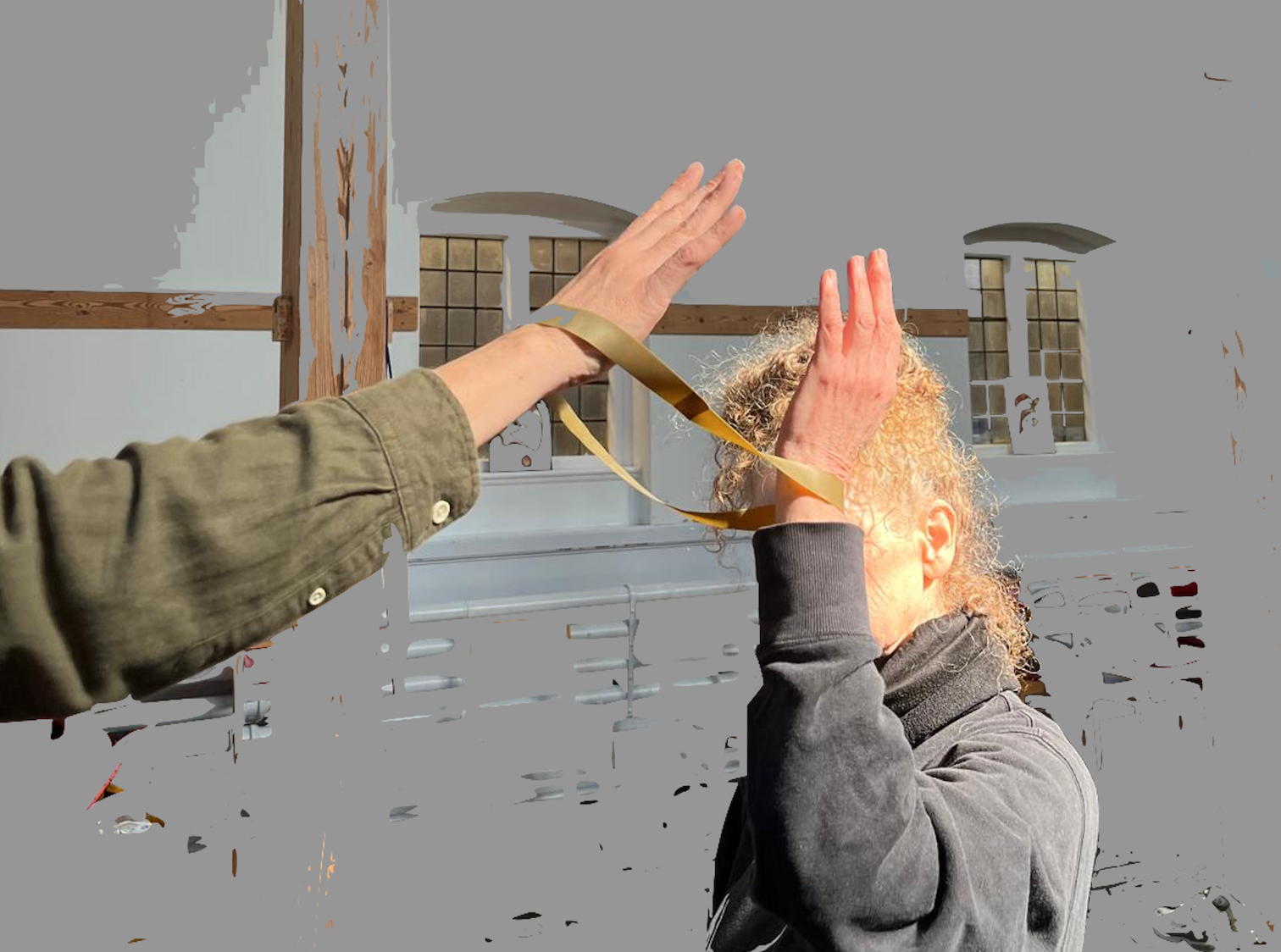
Welcome to the dance of DaNCING𓂃BaND, a gentle, playful, and creative practice that explores bodily intelligence and relation, through the art of moving together.
Working with the elasticity of a specially designed elastic band, the practice offers a simple yet profound approach to embodied learning and communication that nurtures mutual awareness, and sensitivity to self and others.
By supporting each other’s movement pathways, we cultivate presence, empathy and trust.
The benefits of DaNCING𓂃BaND learning can be experienced, reflected, expressed and shared in professional and personal contexts.
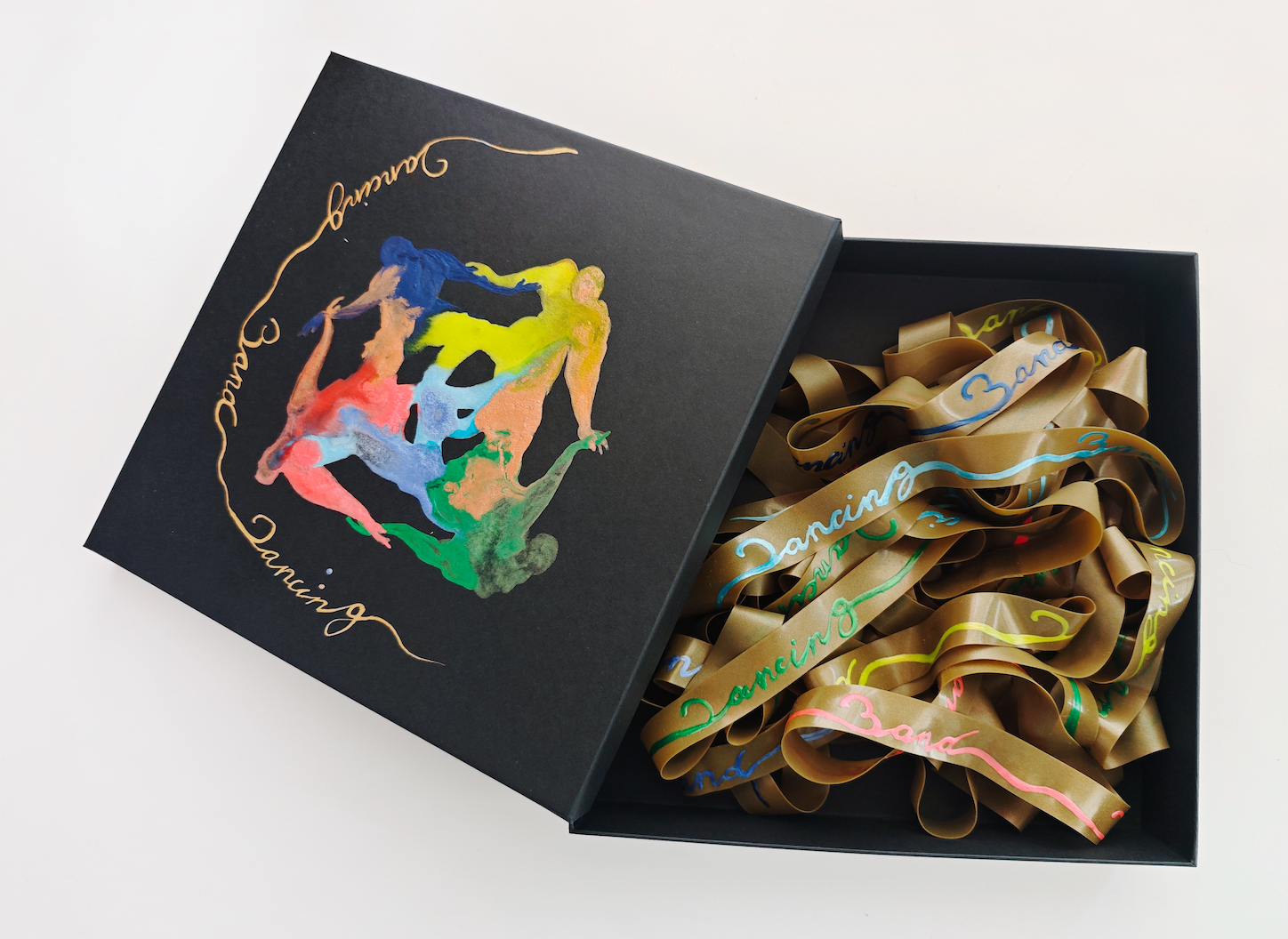


The DaNCING𓂃BaND is a looped natural rubber latex band that connects the wrists of two people to co create an elastic and fluid space between them.
Within DaNCING𓂃BaND practice cultivates attentiveness to what is happening now— a mindful awareness that bridges action and reflection. This experiential approach offers access to pre-verbal, embodied forms of insight that are often submerged under habitual verbal communication. It fosters emotional clarity, empathy, and creativity.
DaNCING𓂃BaND Practice
DaNCING𓂃BaND is a creative pratice with pedagogical applications. Its roots are in the world of dance, art, choreography, and experimental methodologies, where experiential learning, sensory awareness, and reflective practice are central to creativity.
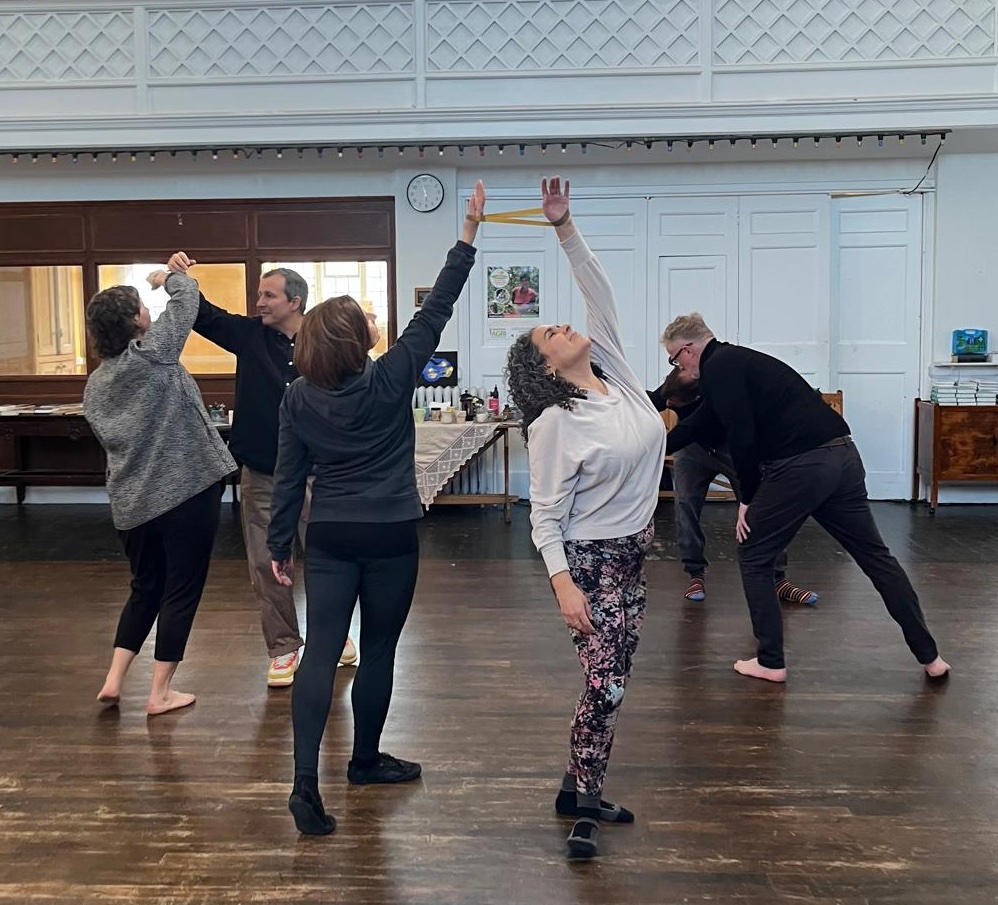
In the practice of DaNCING𓂃BaND, we work in pairs to explore listening — to oneself, to each other, and to the space we create. Movement experiences are explored through guided prompts or spoken scores to open space for exploration, relational exchanged and co-creation. Post-movement reflection through dialogue, writing, or drawing becomes part of the learning process, allowing practicioners to connect physical experience with other forms of understanding.
Through supporting each other in this duet we rediscover the resilient elasticity that exists in relational movement.
Observation and witnessing are also integral — seeing and being seen without judgment cultivates mutual respect, resonance, and trust within the group.
the development of DaNCING𓂃BaND practice
Learn more
- ︎𓂃Becoming a DaNCING𓂃BaND practitioner &
facilitator
Learn more DaNCING𓂃BaND
Practice & Facilitation Training Course
Practice & Facilitation Training Course
2 whole day + self-directed practice + half day (3.5)
The Introductory Practioners & Facilitators Training Course invites embodied and creative understanding DaNCING𓂃BaND practice and develop the skills to facilitate the practice to others, with confidence, attunement, and imagination.
The Grounding Practice 1 hour
Duration: 2 months (?)
Learning pathways, three strands:
- Practice
- Facilitation
- Self Directed Time (Practicing and Facilitating)
- DAY 1 — DaNCING𓂃BaND Practice
Experience the foundations of DaNCING𓂃BaND, and grounding practice
- DAY 2 — DaNCING𓂃BaND Facilitation
Exploring ways to hold the practice for others and create safe, inclusive, and responsive spaces for embodied and creative learning.
- Self Directed Practice & Facilitation
Practioners are invited to undergo 15 hours of self-directed time of both practice and facilitation, deepening their understanding through experience, reflection, and documentation/journaling.
I'd suggest you ideally practice:
ONE TO ONE x 4 times—you and someone you know. You facilitating inside the band
ONE TO TWO people x 4 times— you and two people/pair of people. You are facilitating witnessing and supporting
+ journal
ONE TO FOUR people x 4 times—you and a 2 pair of people. You are facilitating witnessing and supporting
+ journal
Support:
+ link-access to the course scripted content as support materials of the practice and creative sessions, videos, playlists, reading resources, and regular workshop dates to nurture your ongoing practice (live and online).
+ online sessions, if you feel that you need more support I will be available
- DAY 3—as a group we can explore if we like to get together and consolidate with peer support.
How we will grow?
Grounding — The capacity to feel safe in your own presence and to hold space for others.
Sensing Connection — A sensitivity to the ways we move together and influence each other.
The greatness of subtely— The ability to listen beyond words, to feel what is unspoken, and respond with presence.
Embracing Difference — Comfort with movement expressions different to my own; curiosity and courage to explore dissonance as a source of creativity.
Dancing with Uncertainty — step into the unknown and trust the unfolding of experience; joy in exploration rather than attachment to outcome.
Co-Creating Together — Ability to share agency, co-design experiences, and celebrate collective creativity; recognition that every action contributes to the unfolding whole.
Nurturing Flow — Attunement to energy, timing, and well-being in yourself and the group; sensitivity to when to pause, rest, or move forward.
Presence in the Unknown — Groundedness and curiosity in the midst of unpredictability; the ability to respond with clarity, patience, and openness rather than reactivity.
Embodied Wisdom — Understanding that transformation is lived in posture, breath, gesture, and attention; the ability to embody values of care, openness, and co-creation in every movement.
How we will be learning?
Through attuned connection, shared movement, and gentle holding of space.
Through relational practices, mirroring, responsive improvisation, and open-ended scores—practice listening beyond words
Co-creation through collaborative exercises, rotating support and facilitation, and shared decision-making.
Through improvisation, reflection, and integration of relational awareness in movement.
Course Outcomes:
By the end of the training, practioners will:
- understand the principles and ethos of the DaNCING𓂃BaND practice.
- gain embodied experience of working with the DaNCING𓂃BaND groundin practice in pairs and groups.
- develop skills to facilitate the practice with care, clarity, and creativity.
- cultivate embodied awareness, empathy, and co-regulation through movement.
- confidence in holding space for learning, reflection, and creative enquiry.
- integrate the practice into your own contexts.
And widening kindness as we...
- Develop embodied awareness, through attentive movement and relational listening, enhancing presence and sensitivity to self and others.
- Explore movement as a language of empathy and dialogue, cultivating practices that nurture inclusivity, cooperation, and collective intelligence.
- Integrate creative practices, to support wellbeing, focus, and collaborative learning in diverse group environments.
- Facilitate grounding practices, that nurtures trust, care, and interconnection within learning contexts.
- Apply movement-based methodologies, to expand sensory, perceptual, reflective, and communication process in faciliations.
- Design and guide participatory experiences, that balance structure and openness, supporting experimentation and shared authorship.
- Reflect critically and creatively on personal and collective transformations emerging through creative research and embodied learning inquiry.
+
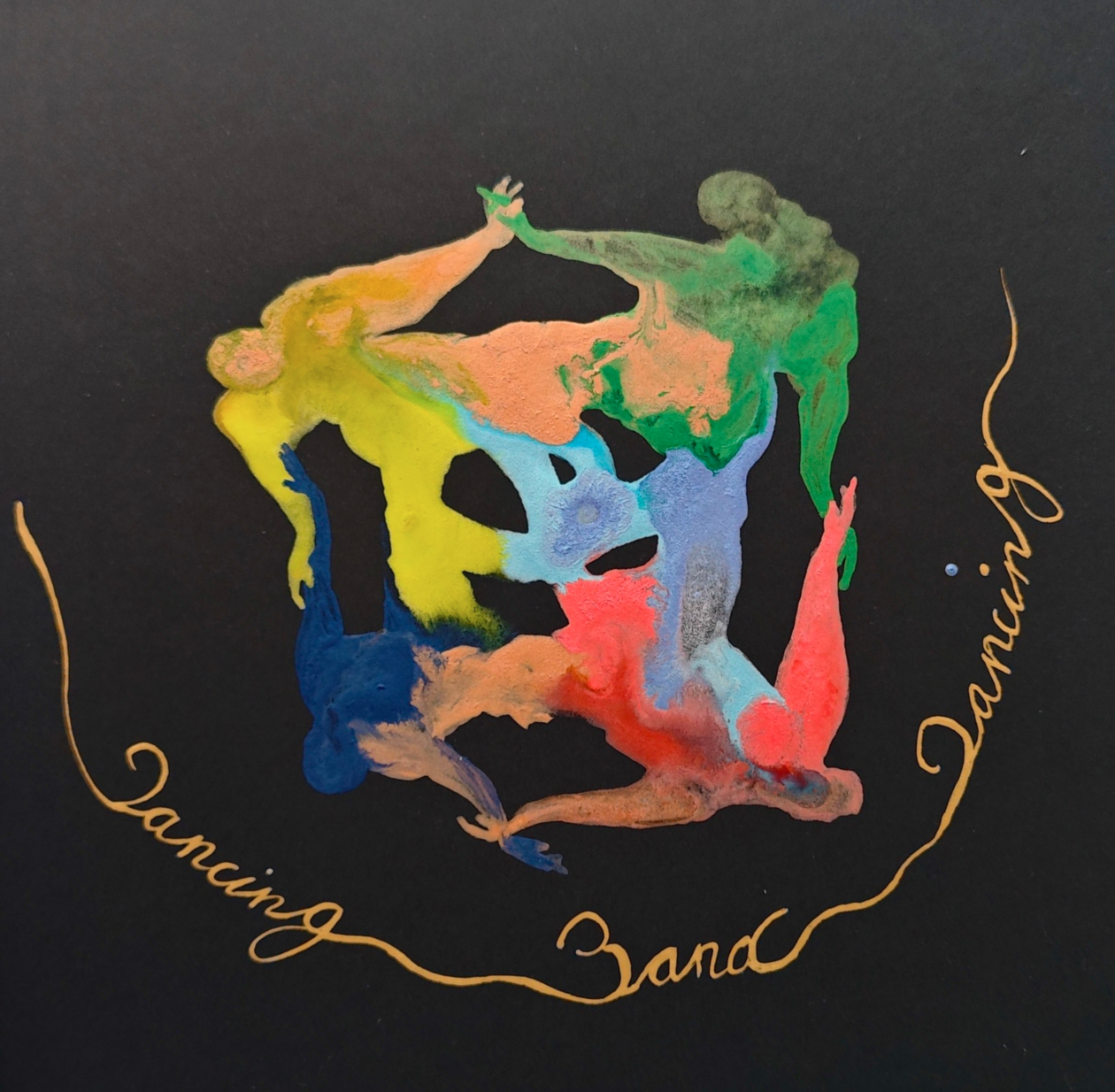
I will make a box for you, with my original artwork, containing 24 hand-painted loop elastic bands, specially designed for DaNCING𓂃BaND practice and facilitation you’ll take with you as part of the course.
(Marga’s note left overs) working through an embodied and creative practice-as-research methodology flexibly,
as within the elasticity of the band, wethe range of the practice is flexible and adaptable to support you and yours groups at different stages in the process of learning embodied movement.
𓂃ADD~ONs
Compositional ideas to accompany the grounding practice.
ADD~ONs are additional movement prompts that can support and deepen your journey into relational and reflective dancing.
They bring new textures and layers to your practice — offering ways to explore a different articulation, how you relate to yourself, others, and the space around you.
- Begin with one ADD~ON at a time. Stay with it for a while before moving to another.
As your practice evolves, you may start to combine several of them together.. -
Have always present with each of them the qualities of attention.
- Choose an ADD~ON that calls you today — or move through them in the order below.
𓂃1#𓂃ALLOWING YES, NO, MAYBE
Allowing YES, NO, MAYBE to be part of the DaNCING𓂃BaND conversation.
Explore what you can allow without effort.
What opens, what closes, softens, or deepens.
Include any resistance as part of the movement. Notice if resistance can transform into constructive expression.
Notice allowing can also included constructive resistance.
𓂃2#𓂃 DANCING FRONTS
Begin by noticing which direction your body is facing.
Explore turning towards different fronts — towards your partner, others in the room, or a new area of space.
Let your whole body move and respond to these changes of direction.
How does it feel to face? To turn away? To move beside?
𓂃3#𓂃STILLNESS / PAUSE / REST
Allow stillness to be part of your dance.
Pause whenever it feels right — between movements, within transitions, or at the end of an action.
Rest in these moments and feel how stillness also moves.
Notice how the dance continues through quietness.
𓂃4#𓂃SOFTENING SIGHT
Experiment with how you use your eyes.
Soften your gaze. Let sight rest.
Try to take in the whole room at once — using your peripheral vision.
Let your other senses begin to orient and guide you: hearing, touch, balance, proximity.
How does softening sight change your movement and your relation to others?
Soften your gaze. Let sight rest.
Try to take in the whole room at once — using your peripheral vision.
Let your other senses begin to orient and guide you: hearing, touch, balance, proximity.
How does softening sight change your movement and your relation to others?
𓂃5#𓂃ALLOWING YOUR OWN PACE, COUNTERING WITH ALL RYTHMS and SOUNDS
Notice the rhythms around you — sounds, breath, movements.
Then, find your own pace.
You don’t need to move with the same beat to be listening.
Let your pulse, your breath, and your weight create their own rhythm.
Play with joining, resisting, and countering the rhythms you sense in the space.
Expand your awareness to include everything around you.
Dance with your partner, the band, the air, the room, the floor.
Let your the sensation of the band on your wrist and skin to ripple through and beyond you.
𓂃7#𓂃 PASSING THROUGH
Let the feeling of the band on your wrist travel through your body — to your feet, head, or spine — like a story unfolding inside you.
Follow its motion as it continues outward, reaching into your partner and the surrounding space, opening the dance beyond yourself.
Notice how movement travels, transfers, and transforms back into you.
Notice how the dance carries your personal experience into the room, and how the room, the band, and your partner, witout judgment.
Stay curious about the flow and reciprocity of motion.
𓂃8#𓂃NOTICING BEGININGs AND ENDs
Enter each movement gently — notice how something begins.
Stay with it as it unfolds.
Then, allow it to end — to dissolve or release.
Observe what happens in the moment between — the space where form becomes formless.
Keep moving between beginning, middle, and end with awareness.
𓂃9#𓂃LEVELS & FOLDS
Explore movement through different levels:
from the floor, to standing, to reaching as high as you can.
Fold and unfold the body — open, bend, spiral, extend.
Use the band or space to travel between levels.
Let transitions between planes be smooth, continuous, or surprising.
𓂃10#𓂃DANCING ELSE
Give yourself carte blanche to move. Let go of all instructions.
Allow the unseen, the imagined, and the not-yet-named to appear.
Move before language — let the dance discover itself through you, the band and your partner.